

|
|
| Home > Direct Response Articles > Database Marketing |
|
|
|
Database Marketing A surprising number of companies fail to look scientifically at database marketing. Your database is the key to survival in bad times. And, it’s the key to maximum profits in good times. The goal of your database is to maximize customer value through conversion, retention and repeat sales. And, it allows you to create new marketing opportunities. Everyone is collecting data on who is, or should be, buying their products or services. This data does not just consist of names and addresses. It includes buying history: what people bought, when they bought, and how much they bought. It also includes birth dates, anniversary dates, marriage status, number and age of children and likes and dislikes. It opens up new ways to market more products and services for both consumer and business-to-business marketers. It means: • New ways to market smarter and reduce costs. • New ways to market additional products or services. • New ways to keep customers—through extended product usage. The business market today is changing rapidly. Those who properly master the understanding of how, what and why customers make purchases, and those who are able to influence buying decisions with highly targeted marketing efforts—email or postal mail, video, telemarketing, etc.—are going to come out on top. Let’s briefly look at the database. Far More Than Just Names 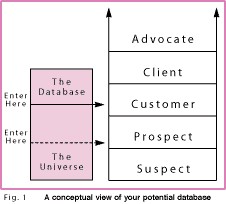
A database is not just a collection of names. It’s a collection of individualized, consumer behavioral information, isolated to each customer. The database concept inputs data and generates information that allows for selective targeted marketing. It provides comprehensive, up-to-date and relevant information about prospects and/or clients, and will pay for itself quickly with visible, measurable sales. Murray Raphael has created two graphics which help show how comprehensive your database can be. New Breakthrough As database marketing has evolved during the past 40 years, it has become more and more cost-effective. In 1973, it cost $7.14 to access a customer’s name, address and purchasing information. Today, it costs about $.01-.02. Building Your Database As you start building your database, the most elementary data collected is your customer’s buying history: what they bought, when, how much and the source of the order.
In fact, you can combine thousands of different characteristics of a customer or prospect to develop a detailed psychographic, demographic or geographic profile Your goal is to ultimately develop a high-quality, long-standing relationship of repeat business. With proper analysis of the database, predictive models can be created to market selectively and with the right frequency. The ultimate result is that you can provide your customers with what they really want, and when they need it. Properly implemented, you can increase your response rate and lower your cost-per-order. The result is higher profits. The Upsell: An Untapped Source of Profit One of the major benefits of a database is that it enables you to aggressively up-sell your customer base. You can: 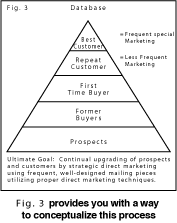
• Sell them more of the same product. • Sell them a more expensive version of the product. • Create continuity or automatic purchases. The pyramid to the left shows a way to conceptualize your database. The Cross-Sell: Marketing 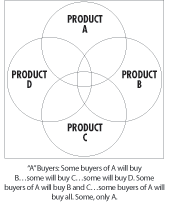
Another important feature of database marketing is cross-selling. What other product can be marketed to your database and secure your relationship with your customer? A database also allows you to develop new products based upon analysis of product/category strengths and buying patterns of brand merchandise.
I’ll be glad to talk to you about these powerful marketing tools. One of them could provide you with the marketing breakthrough you’ve been looking for. Please call me at (310) 212-5727 or email me at craig@cdmginc.com.
|
|
|
Copyright ©2013 CDMG, Inc. All rights reserved. |